

Last week, McAfee warned that economic pressure and AI are creating ideal conditions for online shopping scams.
This week, that warning got another real-world example.
New reporting revealed that cloned shopping websites have appeared in AI-generated search results, potentially directing consumers to convincing fake storefronts designed to steal payment information and personal data.
The incident reinforces what McAfee’s latest research found ahead of Prime Day: shoppers are moving faster, trusting deals more readily, and encountering increasingly sophisticated scams.
Before the summer’s biggest shopping events kick into high gear, let’s get into the sales and Prime Day scams to be aware of and other cybersecurity news making headlines This Week in Scams.

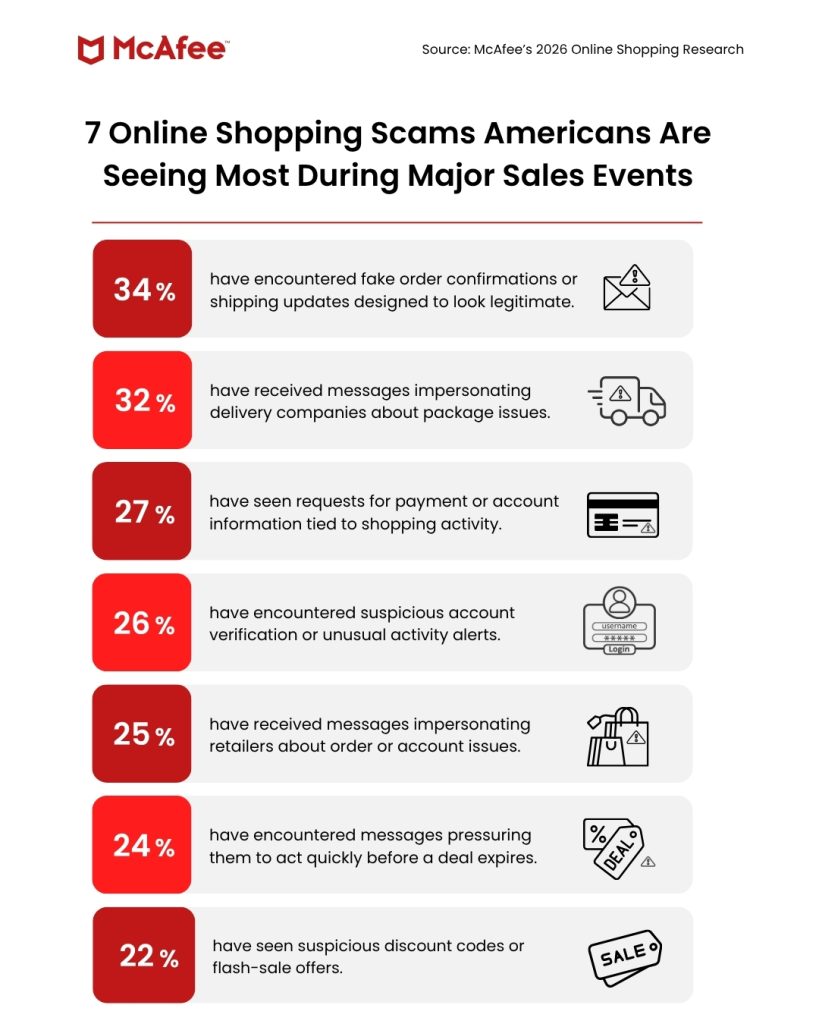
The Top 7 Shopping Scams to Watch for This Prime Day
McAfee’s latest research found consumers most frequently encounter the following scams during major sales events:
- Fake shipping confirmations and order updates (34%)
- Delivery company impersonation scams (32%)
- Requests for payment or account information (27%)
- Suspicious account verification alerts (26%)
- Retailer impersonation scams (25%)
- Fake urgency and expiring deal messages (24%)
- Suspicious discount codes and flash-sale offers (22%)
These scams work because they exploit moments when consumers are already expecting packages, tracking orders, comparing prices, and making quick purchasing decisions.
Prime Day Shopping Safety Checklist
In McAfee’s new consumer research, 40% of Americans surveyed said they would trust a lower priced deal without verifying it. That means as costs are climbing, shoppers are less likely to second guess a too-good-to-be-true deal that could be a scam.
“What the data reflects is that economic pressure has effectively done some of the scammer’s work for them,” says McAfee’s Head of Threat Research Abhishek Karnik.
“When consumers are already primed to move quickly and prioritize price over authenticity, it takes far less effort to push them toward a bad click or a fraudulent purchase.”
And reporting that fake shopping sites have appeared in ChatGPT results shows that scammers are adapting to ensure they show up wherever consumers search for products, including AI-powered search experiences.
That means it’s more important than ever for shoppers to know the red flags, common scams, and protection measures to find deals safely.
Safety Checklist
Before making a purchase:
✓ Verify the website URL
✓ Compare prices across multiple retailers
✓ Research unfamiliar sellers
✓ Be skeptical of discounts exceeding 50-70%
✓ Never trust a shopping link sent by text
✓ Use a credit card instead of bank transfer, crypto, or gift cards
✓ Check independent reviews
✓ Verify shipping alerts directly through the retailer
Other Scam and Security News This Week
Nintendo Investigates Third-Party Employee Data Incident
According to Kotaku, Nintendo is investigating an alleged data exposure involving TinyPulse, a third-party employee survey platform. An extortion group claiming responsibility for the incident says it possesses employee information and internal communications and demanded a $2 million ransom. Nintendo said its own systems were not compromised and that no customer financial or payment information was accessed.
Madison Square Garden Data Allegedly Posted Online
According to 404 Media, hackers linked to the ShinyHunters group have allegedly published data stolen from Madison Square Garden after an extortion attempt. Sample files reviewed by the outlet reportedly contained personal information, talent records, and contact details connected to sports personalities and business operations.
Novo Nordisk Reports Clinical Trial Data Breach
According to Yahoo Finance, Novo Nordisk disclosed a data breach involving individuals participating in clinical trials. The company is currently assessing the scope of the exposure while also managing ongoing supply constraints affecting its GLP-1 medications, including Wegovy.
How McAfee Can Help
With McAfee+ Premium, multiple layers work together before any damage is done:
- Scam Detector flags suspicious texts, emails, links, QR codes, and even deepfake videos before you engage
- Secure VPN keeps your data private, especially on public Wi-Fi
- Web Protection helps block risky sites, even if you do accidentally click helps block risky sites, even if you do accidentally click
- Password Manager doesn’t just help you make unique, strong passwords, it keeps them stored and organized for you
- Device Security helps detect malicious apps or downloads
- Identity Monitoring alerts you if your personal info shows up where it should not, so you can act fast
- Personal Data Cleanup helps remove your information from sites selling it.
- Online Account Cleanup assists in taking down your old, forgotten accounts across the web
- Social Privacy Manager helps you monitor and change privacy settings across your social platforms in just a few clicks
Together, these protections are designed to address the broader range of online risks people face every day.
Plus, click here to get McAfee’s limited-time deals on real-time protection this Amazon Prime Day, from June 23 to June 26.
Stay Updated
Follow us to stay updated on all things McAfee and on top of the latest consumer and mobile security threats.